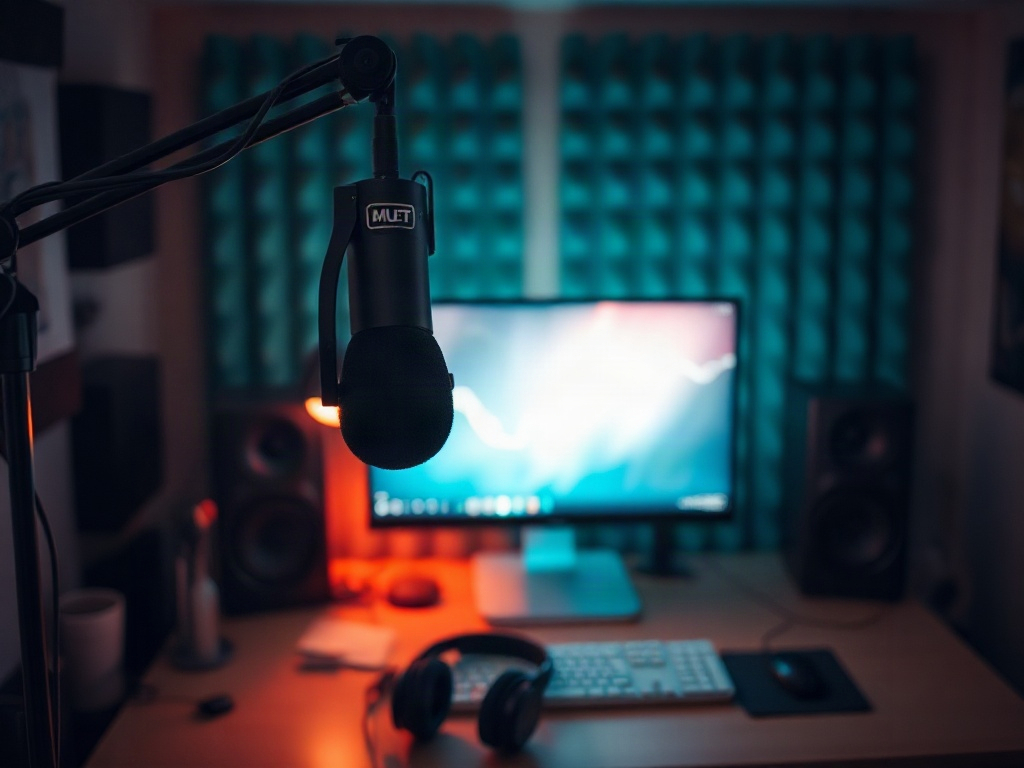
You said the line perfectly. Then you said it again, slightly worse. Now you're on take eleven and your throat hurts and you're starting to hate a sentence that was fine the first time.
If you record anything — a podcast, a voiceover, a YouTube intro, an audiobook chapter — you know the moment. The take was good. It was genuinely good. But you hit record again anyway, because what if the next one is somehow better?
That's "one more take," and it's one of the quietest ways creators lose entire evenings.
The take was fine. That's the problem.
Recording anxiety doesn't usually sound like panic. It sounds like a small voice that says "just once more, to be safe." It's rational-sounding. You convince yourself you're being thorough. You're not — you're stalling, and the stall has a cost.
Every extra take means more audio to sort through later. More files with names like `final_v2_REAL_final_3.wav`. More editing time spent comparing takes that are 99% identical, hunting for a difference that doesn't change how the listener experiences anything.
The irony is that recording is the one part of the process where "good enough" is actually the professional move. Your audience can't hear take eleven. They hear the one you keep. And the one you keep is almost never better than the one you should have stopped at.
Why it feels so much harder than it looks
Recording looks easy from the outside. You sit, you talk, you stop. But the moment the red light is on, every creator's brain switches into a different mode. Suddenly you can hear the ceiling fan. Suddenly your mouth is dry in a way it wasn't thirty seconds ago. Suddenly the word "statistics" has six syllables and you're not sure where they all go.
Here's what's actually happening. When you're recording, you're doing two jobs at once. You're performing the content, and you're also monitoring yourself in real time — listening for mistakes, second-guessing your pacing, noticing every tiny stumble. That split attention is why the tenth take often sounds worse than the second. You're not getting better at it. You're just getting tired and more self-conscious.
The pros all describe the same fix, and it's annoyingly simple: decide how many takes is enough before you start, and stop there. Not when you feel done. When you hit the number.
The retake traps every creator falls into
There are a handful of specific retake spirals that show up over and over. Once you can name them, they're easier to catch in the moment.
The "one word was off" trap. You nailed the take, but one word came out slightly wrong. So you re-record the whole thing instead of just patching that one line. Full retakes are almost never worth it when a quick punch-in would fix it. A single clean line re-recorded in isolation saves twenty minutes.
The "now I'm in my head" trap. Take one was natural. Take two, you started thinking about how take one sounded, and now you're stiff. Each retake adds more self-consciousness. This is the exact opposite of what you want. The loosest take is almost always an early one.
The "comparison paralysis" trap. You've got four takes and you've listened to them so many times they've all stopped sounding like words. Now you can't pick. At this point the difference between them is imaginary — nobody else could tell them apart. Pick the earliest one you didn't hate and move on.
The "I'll fix it in post" trap. This one's sneaky, because it sounds like a solution. You keep recording sloppy takes telling yourself you'll edit it clean. But editing can't restore a performance you never actually gave. A take where you were distracted the whole time stays distracted, no matter how much you cut it.
What the fear is really about
It helps to be honest about what's underneath the retake loop. It's rarely about the audio. It's about putting something out into the world that has your voice on it and might not be perfect.
Voice is personal in a way text isn't. A typo in a blog post is easy to fix and easy to forgive. A wrong word in a recording feels permanent, because your actual speaking voice is on the record. So creators over-record as a kind of armor — if they do enough takes, maybe the final one will somehow be beyond criticism.
It won't be. Somebody, somewhere, will find something to nitpick no matter how many takes you did. The goal was never perfection. The goal is a recording that sounds like you actually talking, and you sound most like yourself when you're not performing for the microphone.
The difference between a good take and a finished one
There's a real skill here that nobody teaches, and it's knowing the difference between a good take and a finished take. They are not the same thing, and confusing them is where most of the lost time goes.
A good take is the best possible version of the thing. A finished take is a version you can ship without it nagging at you for the rest of the week. The gap between them is usually tiny on the recording, but enormous in your head.
Experienced podcasters learn to hear their own audio the way a listener would. A listener hears content — did the story land, was the point clear, did it feel like a human talking. They do not hear the one slightly-too-long pause or the word that was 95% right. Those are things only the person who recorded it will ever notice, and only because they were there for all eleven takes.
That shift is hard to make, but it's the whole game. The sooner you can listen to your own take as an audience member instead of as the person who made it, the sooner "one more take" stops running your evening.
A practical system that actually works
Talking about anxiety is fine, but creators usually want something they can use tonight. Here's a concrete routine that has kept a lot of people out of the retake spiral.
Before you hit record, write down — actually write it, not just think it — how many takes you're allowed and what "done" means. Something like "three takes, pick the best, then move on." Making the decision before you're inside the loop is the whole trick, because inside the loop every take feels like it justifies another one.
Record with a system for marking takes as you go. When you finish a take you're happy with, say a code word into the mic right after — "marker" or "keeper" or just "that one." When you listen back, you'll see the marker and know which take you already trusted, instead of re-judging all of them fresh.
Patch instead of restarting. Most editing software lets you record a small section over an existing take. If one line came out wrong, just redo that line. A fifteen-second patch fixes what a full three-minute retake would have, and it keeps your energy up instead of draining it.
And give yourself a hard stop. Set a timer. When it goes off, you export whatever you have. You can always patch later; you cannot get the evening back.
When the anxiety is a feature
One more thing worth saying, because it's easy to frame all of this as a flaw to fix. Some of that nervous energy is doing useful work.
The creator who cares enough to re-record is the creator who cares about the final product. The problem was never the caring. It's when caring turns into a loop with no exit — when the pursuit of a better take stops being about the listener and starts being about dodging the discomfort of shipping.
Keep the part that makes you redo a genuinely bad take. That's the quality instinct. Just pair it with a limit so it doesn't become a treadmill. Caring hard and shipping anyway is the whole job, and it's a lot easier once you stop treating the red light like a final exam.
A lighter way through it
None of this means recording anxiety goes away. It means you can work with it instead of against it.
Set a take limit and honor it. For a short voiceover, two or three takes max. For a podcast segment, one take, with permission to punch in and fix flubs afterward instead of starting over. Mark your best take as you go — don't wait until the end and try to remember which one felt good.
Accept that your voice is going to sound weird to you. Everyone's does. You hear your own voice through your skull when you talk, so a recording always sounds like a slightly different person. That's not a flaw in the recording. It's a trick of anatomy. Stop judging the take by whether it sounds "like you," because it never will to your own ear.
And remember what you're actually making. A recording is a means to an end — an episode, a video, a product. It's not a performance for its own sake. The sooner you treat "done" as the goal instead of "flawless," the sooner you get to ship something.
Wear the grind you're already living
If you've lost an evening to "one more take," you're not alone. It's one of those invisible parts of making things that nobody watching ever sees, but every creator knows. The merch at Hoojump is built for exactly that — the behind-the-scenes work, the inside jokes, the "99% AI, 1% PANIC" reality of putting your voice out into the world.
Pick up something that names the part of the job nobody else sees:
- The "99% AI, 1% PANIC" shirt — for the creator who re-recorded a sentence fourteen times and still picked take two.
- The full PixelPunch collection — tees, hoodies, mugs, and stickers for the people who make the internet.
The take was fine. It usually is. Stop recording, hit save, and go put the thing out. Your merch is already waiting at hoojump.com.