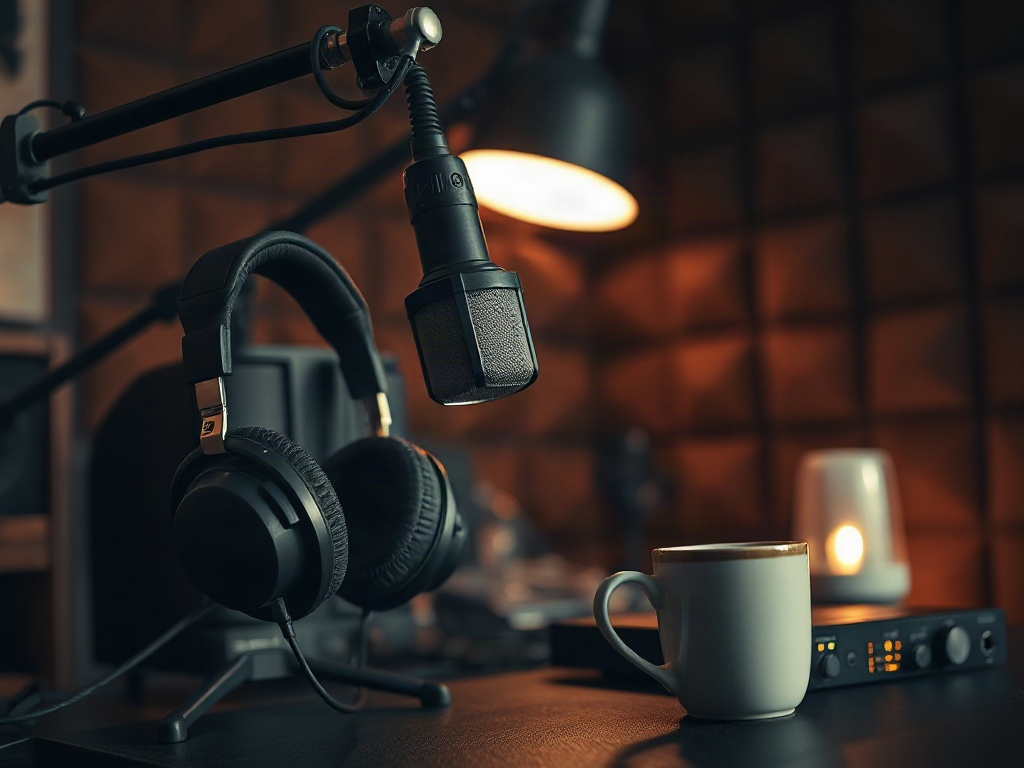
Nobody warns you about headphone hair.
You sit down to record a podcast episode or a voiceover, put the cans on, and forty minutes later you stand up looking like you lost a fight with a vacuum cleaner. The flat band, the dent in the top of your skull, the little groove where the padding sat — it's the one part of the job that shows up in every mirror and no analytics dashboard.
Audio creators live a strange double life. On one side, the polished version: the clean waveform, the warm vocal tone, the episode that sounds effortless. On the other side, the reality behind the mic — pop filters covered in breath spray, tangled XLR cables, a desk that's ninety percent equipment and ten percent space for an actual human being.
This one's about the side nobody sees. The studio life that doesn't make it into the final export.
The room you record in is never the room you imagined
Every audio creator starts with the same fantasy: a soundproofed booth, acoustic panels arranged just so, the kind of silence that makes your voice sound expensive.
Then reality hits. You record in a closet with clothes acting as bass traps. You record under a blanket at two in the morning because that's when the neighbors finally stop. You record in a room with a refrigerator, a window, and a distant highway that only becomes audible when you're three minutes from the end of a perfect take.
The truth is that most creators never solve the room. They work around it. They learn which corner has the least echo, which blanket kills the most reflections, and exactly how close to the mic they need to get before the room noise disappears under the signal. It's not glamorous. It's just the job.
Pop filters: the ugliest, most necessary piece of gear you own
A pop filter is a nylon hoop that sits between your mouth and a very expensive microphone, and it looks like something you'd use to strain pasta. It catches the plosives — the hard "p" and "b" sounds that make your mic sound like it's being hit with a gust of wind — so your listeners never hear the spit you're politely not mentioning.
Over time, a pop filter becomes a small museum of your recording history. A faint fog of dried breath spray. A crumb from the snack you swore you'd finish before recording. A fine dusting of everything you've ever said within six inches of a microphone.
You'll replace the nylon sock on it once, realize the replacement costs almost as much as a new filter, and then just keep using the old one forever. Every audio creator owns a pop filter they've had too long. It's a rite of passage.
The cable and gear situation nobody photographs
Scroll any audio creator's social feed and you'll see the hero shots: the microphone, the interface, the headphones lit like a product ad. What you won't see is the three feet behind the camera, where every cable you own has formed a single living organism.
XLR cables tangle in the dark. A USB hub hums with five things you're not sure you still need. There's a pop filter mount that only tightens if you hold it at a specific angle, and a mic arm that droops exactly one inch after you've walked away. You tell yourself you'll cable-manage next weekend. Next weekend never comes, because next weekend you're recording.
Then there's the quiet arithmetic of the setup ritual itself. Before any session, you go through the same sequence without thinking: check the interface is on, check the gain isn't clipping, tap the mic to make sure it's armed, put the headphones on, hit record, and say the same two test words into the void to confirm the level. Then you do the real take, and somewhere in the middle of it a notification dings, or the chair creaks, or you realize you've been sitting wrong the whole time and your back is going to hate you. You start over. The gear is never the hard part. The repetition is.
Why audio creators are the last to hear their own work as "finished"
Here's the quiet paradox of the craft. You can spend three hours recording, editing, and mixing an episode, and the moment you export it, all you hear are the flaws.
That breath you didn't cut. The plosive that slipped past the filter. The chair creak at the two-minute mark that you're now certain everyone will notice, even though absolutely no one will. Audio creators don't finish projects. They reach a point where the remaining problems are small enough to live with, and they call it done.
It's the same muscle that makes you a good editor — the ear that hears what's wrong. It's also the thing that keeps you up at night after you've already hit publish.
Where the "99% AI, 1% PANIC" line actually lands for audio
If you've been anywhere near creator merch, you've seen the line: "99% AI, 1% PANIC." For audio creators, it hits different than it does for everyone else.
Most of the audio pipeline is now, quietly, automated. Your DAW does the noise reduction. A plugin de-esses the harsh "s" sounds. AI tools level your loudness, strip the room tone, and clean up the mouth clicks you spent an hour editing by hand a few years ago. Ninety-nine percent of it runs itself.
The one percent is the part no tool can do: the take where your voice cracks because the line actually means something, the ad-lib that turned out better than the script, the decision to keep a mistake because it made you sound human. That's the one percent, and it's the whole reason anyone listens to you instead of a text-to-speech robot.
That's the joke baked into the shirt — the tools do almost everything, but "almost" leaves a gap only a person can close. Audio creators live in that gap every day.
Give the audio creator in your life something that names the real job
If someone in your life records, edits, or mixes audio, you already know the gift problem. They own the gear. They've researched every microphone under the sun. The last thing they need is another cable or a pair of headphones they didn't pick out themselves.
What they don't get is something that names the actual life behind the mic — the headphone hair, the pop filter museum, the one percent of panic that keeps them human. That's the merch that lands, because it's the one thing you can't buy for yourself: proof that somebody sees the invisible work.
A shirt or a mug that jokes about the behind-the-scenes reality says "I know what you actually do all day" better than any piece of gear ever will. And for a creator who spends their week alone in a room talking to a microphone, that recognition is worth more than any new interface.
FAQ: the questions every audio creator's people ask
Why does my audio creator's desk look like a cable farm? Because audio gear multiplies. Every new mic, interface, and monitor comes with its own cable, and none of them are the same length or connector. The tangle is not laziness — it's entropy, and every audio creator is one weekend of cable management away from fixing it (they just keep recording instead).
What's a good gift for a podcaster or audio creator? Skip the gear — they've already researched it more than you have. Give them something that names the actual job: headphone hair, pop filters, the one percent of panic no AI can handle. A shirt or mug that jokes about the behind-the-scenes reality says "I see the work you do" better than any microphone accessory.
What does "99% AI, 1% PANIC" mean for audio creators? It names how modern audio work actually feels. Noise reduction, de-essing, loudness, and cleanup are now automated — that's the ninety-nine percent. The one percent is the human judgment no tool can replace: the takes, the mistakes, and the decisions that make a recording feel alive. Audio creators spend their whole week in that one percent.
Pick up something that names the real work at Hoojump:
- The "99% AI, 1% PANIC" shirt — for the creator calmly handling the one percent while the tools do the rest.
- The "Did You Restart It?" shirt — for the audio creator who has, in fact, restarted the interface, the DAW, and the computer, and it still didn't fix it.
- The full PixelPunch collection — tees, hoodies, mugs, and stickers for the people who make the internet sound good.
Behind every clean waveform is a person with headphone hair and a pop filter museum. It's time they got merch to match at hoojump.com.